
In Kosovo, youth are often hailed as the hope of change. Politicians invoke them in every speech; organizations celebrate them in every report. Yet, in practice, when one looks at young people within political parties, the question is no longer “Are they bringing change?” but rather “Are they safeguarding the old order?”
Two recent reports—one by the Sekhmet Institute on Political Representation of LGBTIQ+ Persons and the other, Assessment of Anti-Gender Movements and Resistance in Kosovo published by CSGD—paint a picture that contradicts the rhetoric of hope. Instead of advancing new ideas of equality, justice, and inclusion, young politicians in Kosovo are reproducing the same conservatism they have inherited from their leaders.
According to Sekhmet’s analysis, none of the youth forums of the main political parties—Vetëvendosje, the Democratic Party of Kosovo, the Democratic League of Kosovo, and the Alliance for the Future of Kosovo—have a clear policy or stance on gender equality or LGBTIQ+ rights. Most avoid these topics altogether. In some cases, they refer to them as “sensitive issues” or “not a priority for the electorate.” Instead of speaking of equality, they speak of “traditional values.” Instead of seeking new spaces, they reinforce old walls.
In their political programs, phrases like “traditional family” and “social morality” appear far more often than “equality,” “care,” or “rights.”
The Report on Anti-Gender Movements in Kosovo (2025) reveals that the country has become part of a new conservative wave sweeping through the region—an alliance between certain religious figures, politicians, and activists who invoke the narrative of “protecting the family” to hinder gender equality.
In this nameless network, often financed through organizations with international ties, the word “gender” has been turned into a weapon. Across social media, television, and public speeches, it is portrayed as a symbol of the “Western threat,” something to be stopped before it “destroys our youth.”
Amid this climate of fear and moralizing, young politicians have chosen silence—not because they fail to grasp the danger, but because it is easier to adapt to it. In interviews conducted by Sekhmet with members of youth forums, many admitted to avoiding queer or feminist topics because “the electorate wouldn’t understand” or “it doesn’t bring votes.”
This self-censorship is a softer form of fear—the fear of stepping out of line, of speaking differently from the party, of risking one’s career. And so, instead of challenging the system, young people are becoming part of it.
Yet this phenomenon extends beyond political parties. According to the Anti-Gender Movements report, it is part of a broader strategy that spans public discourse, the education system, and the media. In all three, the identities of women and queer persons are treated as “issues for debate,” not as realities that require protection and equality. Thus, equality becomes a threat, and hatred an opinion.
At the same time, this discursive climate has tangible consequences. When emerging political leaders speak of “national morality” and the “danger of gender ideologies,” they are not engaging in intellectual debate—they are creating the conditions that justify violence. In a country where domestic violence remains a daily reality, where reports of attacks against queer persons go unpunished, such rhetoric is fuel to an already burning fire.
Will the youth ever challenge this order?
Political youth should have been the force to free politics from fear. Yet in reality, they are sustaining it. Instead of seeking new spaces for equality and justice, they retreat into the same words used by the older generation. Instead of speaking of rights, they speak of “identity.”
Instead of fighting inequality, they take selfies at party congresses.
The Sekhmet report notes that political youth in Kosovo are replicating the very patriarchal model they claim to replace. And this is not merely criticism—it is a warning. Because if the youth fail to understand that gender equality and the right to be different lie at the very core of democracy, not at its periphery, then any future “change” will be purely cosmetic—a new generation with the same conservatism, only better packaged.
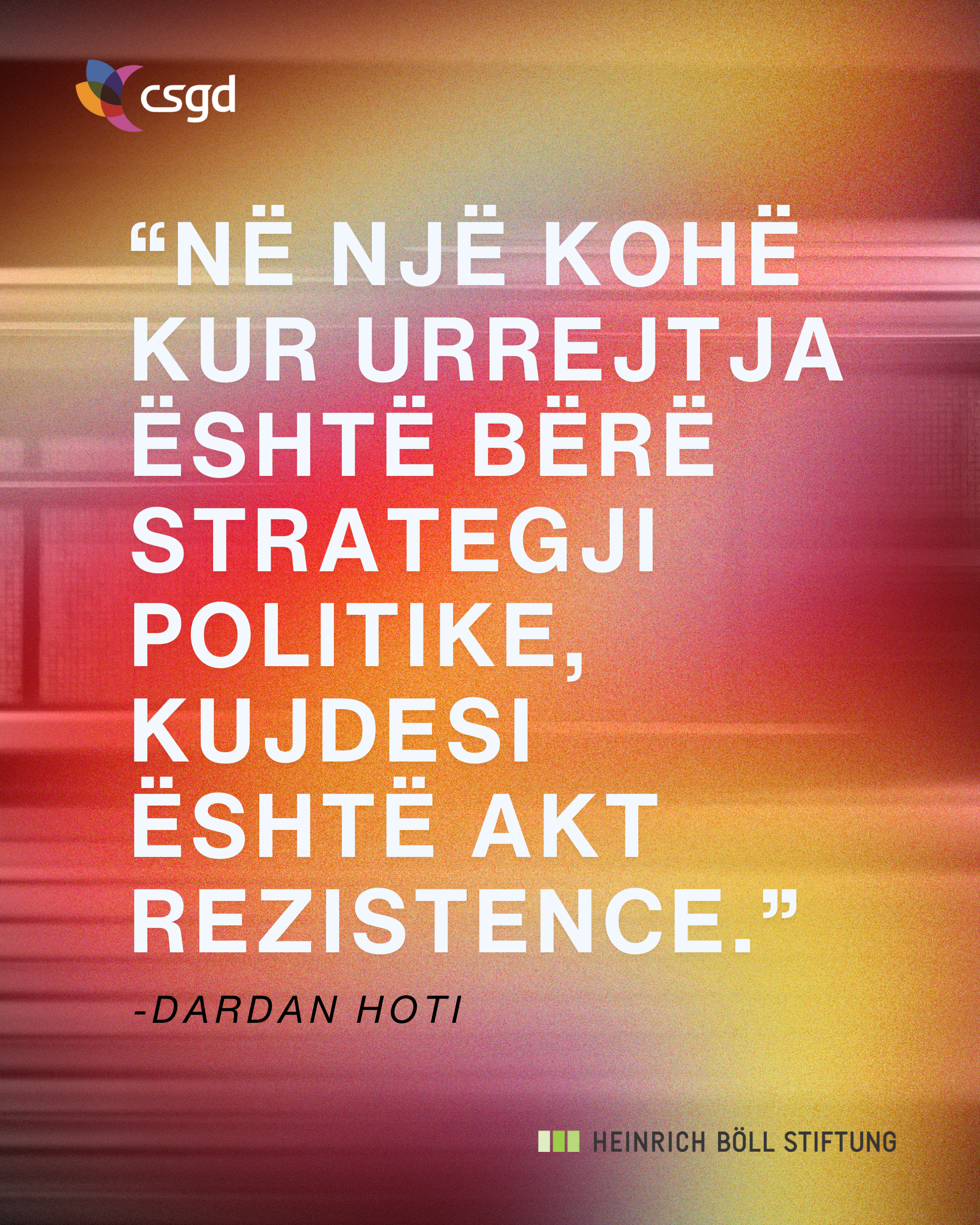
Yet beyond party walls, there exists another generation—of activists, feminists, and queer organizations—who, without fanfare or power, are building another kind of politics: one of care, solidarity, and shared life. In a time when hatred has become a political strategy, care itself is an act of resistance. If there is any hope for change, it does not come from podiums, but from streets, community centers, protests, and small spaces where marginalized people no longer seek approval, but justice.
In the end, the question remains the same: is the political youth challenging the status quo—or preserving it in a new uniform? Because change does not come with age; it comes with courage. And until courage appears, the youth will remain nothing more than a slogan in the speeches of aging politicians.
Written by: Dardan Hoti