
In November last year, Kosovo was swept by a wave of reactions that at first glance seemed like parental concern, but soon revealed themselves as an organized political campaign. At the center of the storm were the sexual education handbooks presented by the Ministry of Education — a supportive material prepared to help teachers speak with students about the body, reproductive health, and healthy relationships.
Instead of being welcomed as a step toward informing and protecting children, the handbook triggered a loud storm of criticism. Politicians, journalists, and conservative commentators hurled heavy accusations, calling the sexual education manuals “immoral” and even “child abuse.” In the parliamentary session of November 11, MP Eman Rrahmani, a former member of Vetëvendosje and now part of the “List for Family,” grotesquely distorted the content of the manuals, claiming that they instructed “a boy and a girl to touch each other for five minutes in front of the class.”
Rrahmani’s rhetoric was quickly amplified through media and social networks. Opposition figures — especially from the List for Family, supported by politicians from the LDK — seized the moment to incite public anger against sexual education in schools. The LDK leader, Lumir Abdixhiku, declared at a rally, “Keep your hands off the family; keep your hands off the children.” His words were met with thunderous applause from a frightened crowd haunted by the specter of an imaginary danger. Within days, several municipalities — including Prishtina, Skenderaj, Vushtrri, and Fushë Kosova — announced bans on using the handbooks in schools.
Under the pressure of this orchestrated campaign, even the Ministry of Education openly backed down, withdrawing the handbooks from use. Meanwhile, Prime Minister Kurti released a social media video emphasizing that the government “focuses on families and children,” showing a lack of courage to address the issue directly. Thus, institutions chose silence and retreat over defending the right to inclusive education.
And so, sexual education — once a neglected and whispered topic — suddenly became the target of propaganda and fear. It took only a pinch of disinformation to portray it as a social threat. But at its core, this was never a debate about the actual content of the handbooks. It was a battle over ideas and values — an offensive against the very principle that children (especially girls) should know and decide about their own bodies. Claims that “sexual education corrupts morality” or “endangers children” are familiar refrains wherever conservative forces seek to reclaim social ground.
The use of children as moral shields is an old tactic of patriarchal politics: frighten the public, spread falsehoods, confuse parental instincts with religious prejudice, and convince society that youth empowerment is a threat. The assault on these handbooks is, in essence, an assault on girls’ right to knowledge. Because a girl who knows her body, who understands consent, who recognizes sexual violence and how to protect herself — that girl is free. And the freedom of girls has always been the greatest threat to systems built and sustained upon their oppression.
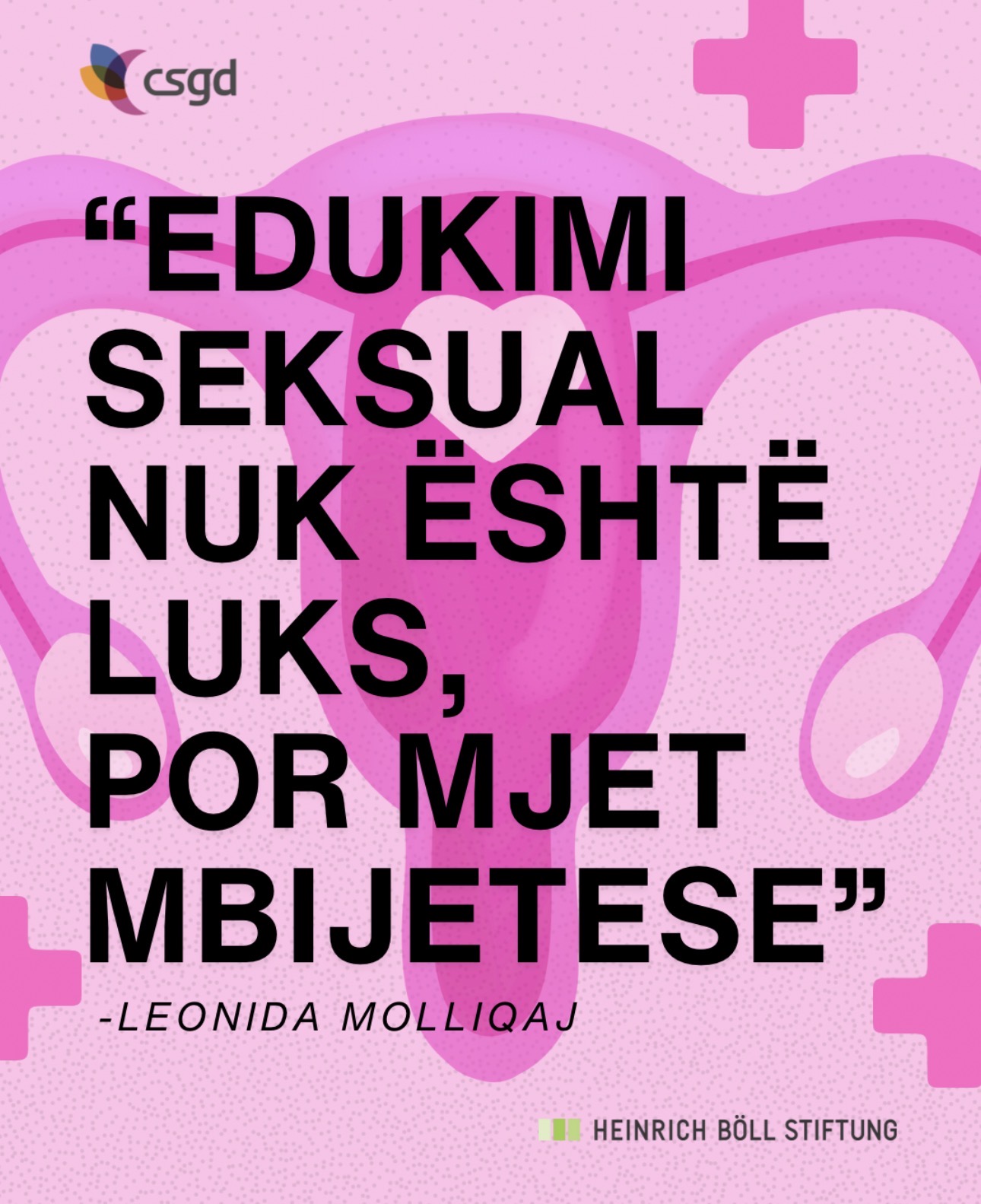
Sexual education is not a luxury — it is a means of survival. To equip children with knowledge about their bodies, relationships, and sexuality means to protect them from abuse, early unwanted pregnancies, sexually transmitted diseases, and needless shame or stigma. Countless studies have shown that children who receive comprehensive sexual education are less likely to experience gender-based violence and more capable of building healthy relationships with their peers. Stigmatizing this subject does not protect children — it leaves them in darkness and makes them more vulnerable.
What happened in Kosovo is not an isolated episode. Behind this campaign stands the so-called anti-gender movement — a transnational network of conservative, religious, and nationalist groups operating with the same strategy worldwide. They claim to defend “the family” and “traditional values,” but in truth, they seek control over bodies and freedoms, especially those of women and LGBTQ+ people.
In Poland, ultra-conservative movements pushed the government to nearly ban legal abortion and even threaten teachers with prison for mentioning sexual orientation or contraception in classrooms. In Hungary, Viktor Orbán’s government passed laws banning references to LGBTQ+ people in school materials, absurdly equating them with pornography and pedophilia. In the United States, states like Florida enacted “Don’t Say Gay” laws that forbid discussing gender identity and sexual orientation in elementary schools. In Brazil, under Jair Bolsonaro’s rule, sexual education programs were dismantled, and over 200 local bills were proposed to prohibit any discussion of gender and sexuality in schools.
In all these cases, the narrative and propaganda tools are identical. This is an anti-democratic trend disguised as a defense of “values” — but in truth, it tramples human rights. The United Nations has warned that by 2024, nearly one in four countries has reported setbacks in women’s rights. In other words, we are living through a global backlash that threatens to undo decades of progress on gender equality. This endangers not only women and girls but also the very democratic foundations of societies.
Today, the girls and women of Kosovo face real risks that decades of progress may melt away like sand. In our schools, cases of sexual harassment and gender-based bullying are rising. If this continues, tomorrow we will have more young men who see violence against women as normal — and more young women who accept injustice as destiny.
But this is not a battle of girls versus boys. It is about teaching all children the values of respect, equality, and empathy. It is about ensuring that today’s boy does not become tomorrow’s abuser — and that today’s girl does not become tomorrow’s victim. Education alone can do this.
In this entire struggle, the behavior of institutions is decisive. Their silence and retreat in the face of anti-gender attacks are as dangerous as the propaganda itself. When the Ministry of Education withdraws or “reconsiders” the idea of sexual education, it legitimizes the disinformation campaign. When major political parties fear speaking openly about reproductive rights or protecting marginalized communities, they cede ground to conservative extremists.
The sexual education handbooks may have had technical flaws to correct — but the idea of sexual education itself must never be questioned. These are red lines that a democratic society must not cross. Those who fear informed and free bodies of girls, in truth, fear their power to change the world. At a time when propaganda and fear seek to turn back the clock, our response must be clear and courageous:
Children have the right to know, to understand, and to protect themselves. This right is non-negotiable.
“Never forget that all it takes is a political, economic, or religious crisis for women’s rights to be called into question. Those rights are never permanently won; you must remain vigilant forever.”
These words by Simone de Beauvoir, written decades ago, echo hauntingly today. The rights we fought so hard to gain can be taken away in the blink of an eye — unless we defend them. That is why we will defend sexual education — and the rights that come with it.
By Leonida Molliqaj